


Sourcing commercial coffee supplies in Dubai presents a recurring choice between importing directly and buying from a local trade supplier. Direct import almost always looks cheaper on the original quotation. Local supply usually wins once freight, customs clearance, spare parts availability and operational downtime are counted properly against it. This guide sets out how to compare the two routes honestly against each other, and explains which product categories genuinely suit each approach for a working cafe operation anywhere in the Emirates.
Key Takeaways
- Direct import can lower unit cost but introduces customs clearance, freight timing and currency exposure that rarely appear anywhere in the original quotation.
- Spare parts availability is usually the deciding factor, because an imported item with no local spares turns a trivial failure into extended operational downtime.
- A hybrid approach serves most operators best, importing slow moving capital items while buying fast moving consumables from local trade stock.
What Direct Import Actually Costs
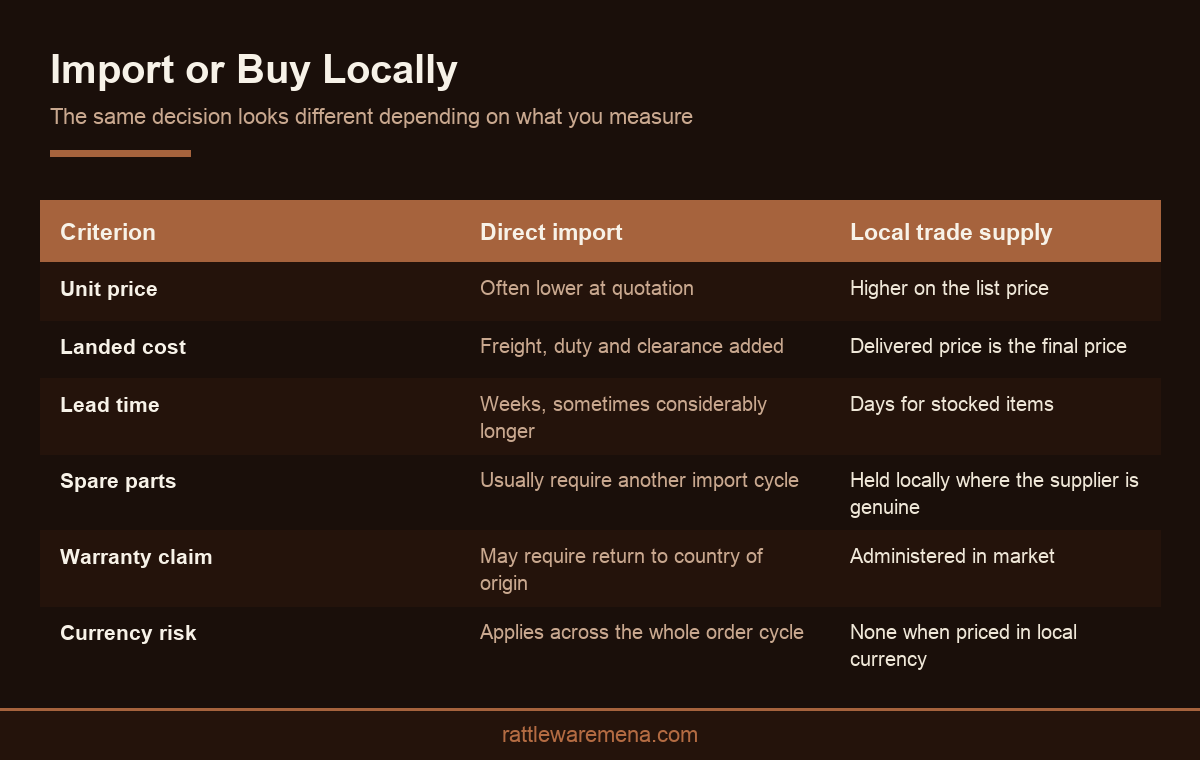
The quoted unit price is the beginning of the calculation rather than the end of it. Several substantial costs attach before goods ever reach your counter.
Wider market context helps here too. Trade data published by the International Coffee Organization tracks how global coffee flows move, and freight conditions on those routes feed directly into what imported equipment costs to land.
Freight is the obvious addition, and it varies considerably with volume, route and whether goods travel by sea or by air. Customs clearance follows, along with any applicable duties and the administrative time required to process the documentation correctly. Currency exposure applies wherever the invoice is denominated in something other than the local currency, and exchange rates move between the point of order and the point of settlement.
Duty treatment varies by product classification, which is worth confirming rather than assuming, since a misclassification discovered at clearance creates both delay and unexpected cost.
Then comes the cost that never appears on any invoice, which is simply time. Sea freight timelines are measured in weeks, and any delay along the chain extends that further. For capital equipment ordered well in advance of an opening this is entirely manageable. For anything you might need at short notice it introduces a category of risk that local buying does not carry at all.
That risk has a genuine operational price even though it never gets quoted. A bar running one grinder cannot wait three weeks for a replacement burr set. The correct way to account for import is therefore to add an allowance for the expected cost of waiting, which for high use items can comfortably exceed whatever saving the unit price appeared to offer.
Why Spare Parts Usually Decide It
Equipment fails in small ways long before it fails completely. Whether a small failure becomes a one day problem or a one month problem depends entirely on local spares.
A hardened group gasket, a dulled burr set or a cracked tamper base are all routine maintenance events rather than disasters. When the part is held locally the fix takes a day and nobody outside the bar notices. When the same component has to be imported, a trivial part can leave equipment degraded or completely unusable for weeks while a shipment is arranged and cleared through customs.
That asymmetry is the single strongest argument for buying anything with wearing parts from local stock. It is also the argument most often overlooked during procurement, because at the point of purchase everything is new and nothing has failed yet. The failure arrives later, usually at the least convenient moment, and by then the sourcing decision cannot be revisited.
The question to put to a supplier is therefore not simply whether they sell an item, but whether they stock its spares in the country right now. Suppliers holding genuine local inventory answer that immediately and specifically. Our guide to evaluating coffee accessories suppliers in Dubai covers the questions that separate real local stock from a dropshipping arrangement presented as availability.
Which Categories Suit Which Route
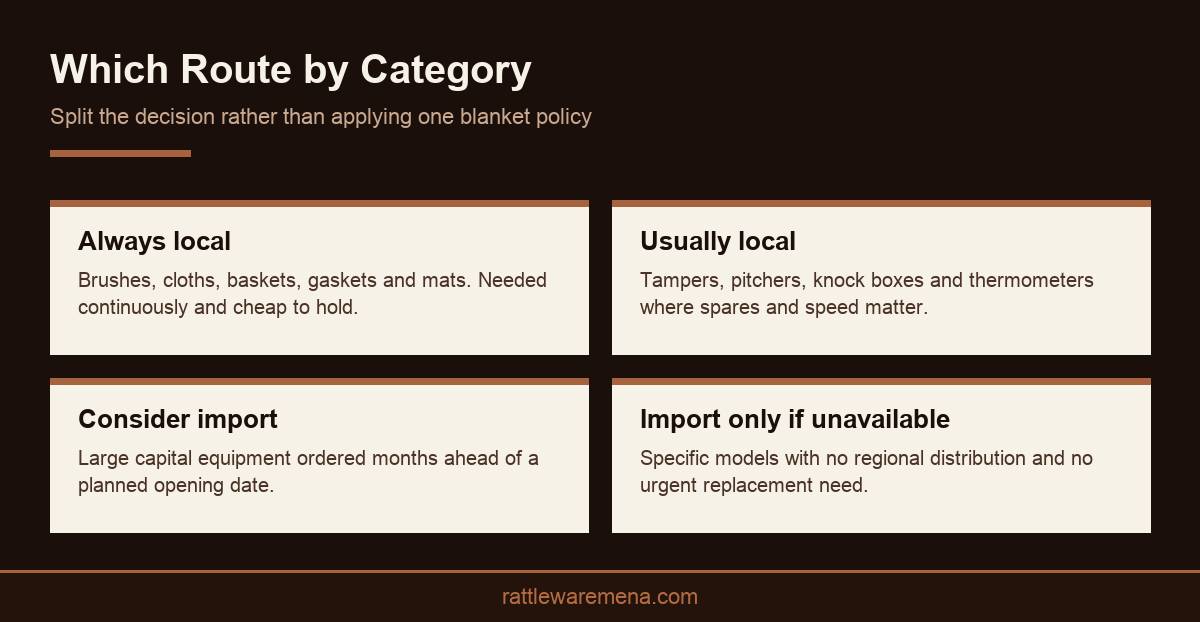
The right answer differs by product category. Splitting the decision rather than applying a single policy across everything produces a much better commercial outcome.
Applied to commercial coffee supplies specifically, the split tends to be clearer than operators expect once it is written down. The categories that cause genuine operational pain when they run out are almost always the cheap ones, and the categories that justify import economics are almost always the expensive ones bought rarely.
Fast moving consumables belong locally without much debate at all. Brushes, cloths, filter baskets and tamping mats are needed continuously, cost relatively little individually and would be genuinely absurd to import in the small quantities a single site consumes. Buying these through a local trade account also consolidates ordering and usually improves pricing through combined volume across the whole range.
Large capital equipment ordered several months ahead of an opening is the clearest candidate for direct import, particularly where a specific model simply has no regional distribution. Here the long lead time is planned rather than disruptive, and the unit saving on a substantial purchase can be meaningful enough to justify the additional administrative work involved.
Between those two poles sits everything else, and one question resolves most of it. How quickly would you need a replacement if this item failed during service on your busiest trading day? If the honest answer is measured in days, buy locally. If it is comfortably measured in weeks, import becomes a reasonable option worth pricing properly.
Comparing the Two Routes Properly
A fair comparison puts both routes onto the same basis, counting every cost that attaches before the item is actually working on your counter.
Build the comparison as landed cost rather than unit price. Take the quoted unit figure, add freight, clearance, duty and any expected currency movement, then add a reasonable allowance for the operational risk carried by a longer replacement cycle. Compare that total against the local delivered price including any trade discount you would qualify for on a consolidated order.
Frequently the gap narrows sharply once this is done properly. For smaller orders it closes entirely or reverses, because freight and clearance costs do not scale down proportionally with order size. This is why direct import tends to make sense for large single purchases and much less sense for the steady replenishment that actually characterises cafe operations.
Trade shows are a useful place to test both routes at once. Events such as Gulfood bring regional distributors and international manufacturers into the same hall, which makes it straightforward to compare what is genuinely stocked locally against what would require a full import cycle to obtain.
Building a Hybrid Sourcing Policy
Most established operators end up running both routes deliberately rather than choosing one. A written policy keeps that split consistent as the business grows.
A hybrid policy assigns each category a default route and a reason. Consumables and wearing parts default to local supply because replacement urgency governs. Large capital items with long planning horizons default to whichever route offers better landed cost. Everything else defaults to local unless a specific case is made, which keeps the decision simple for whoever is actually placing orders.
Writing the policy down matters more than it sounds. Without it, sourcing decisions get made individually by whoever happens to be ordering, and the result drifts toward whatever looked cheapest that week. A single page setting out the default route by category keeps purchasing consistent across sites and across staff changes throughout the year.
Review the policy annually against what actually happened. If a category assigned to import generated repeated downtime, move it local. If a locally bought item never once needed urgent replacement, it may be a candidate for import at better pricing. Our guide to commercial coffee equipment for different business types helps frame those category decisions by operation.
Conclusion
Deciding how to source commercial coffee supplies in Dubai comes down to landed cost and replacement risk rather than headline unit price. Import where lead times are genuinely predictable and the item has no regional distribution at all. Buy locally wherever spares matter or replacement urgency is real, which covers the large majority of what a working bar actually consumes across a year. A hybrid split serves most operators best. To review what is held locally, browse the full range.
Frequently Asked Questions
Is importing commercial coffee supplies in Dubai cheaper than buying locally?
Sometimes on unit price, but rarely on landed cost. Freight, customs clearance, duty and currency movement all attach before goods ever arrive, and longer replacement cycles carry a real operational cost that quotations never show anywhere.
What is landed cost and why does it matter?
Landed cost is the total price of getting an item working on your counter, including freight, clearance, duty and currency movement. It is the only fair basis for comparing an import quotation against a local delivered price.
Which coffee supplies should always be bought locally?
Anything consumed continuously or carrying wearing parts that fail predictably over time. Cleaning brushes, cloths, filter baskets, gaskets and tamping mats all fall here, because replacement urgency makes long import lead times completely unworkable in practice.
How long does customs clearance usually take in the UAE?
Timelines vary with documentation accuracy and the shipping method chosen. The practical planning point is that clearance adds meaningful time beyond transit, so any item you might need urgently should never depend on an import cycle.
What happens if imported equipment fails under warranty?
Warranty claims on directly imported equipment often require returning the item to its country of origin, which is both slow and expensive. Locally supplied equipment usually carries a warranty administered in market, which is materially faster to resolve.
Can a small cafe realistically import equipment directly?
It is possible but rarely efficient at small volumes, since freight and clearance costs do not scale down proportionally with order size. Most independent operators find local trade supply more economical once handling time is counted honestly.
Does currency movement really affect equipment pricing?
It can, particularly on longer lead times where several months pass between placing an order and settling it. Buying in local currency from local stock removes this exposure entirely, which simplifies budgeting for operators planning multiple sites.
How do I verify a supplier holds genuine local stock?
Ask how many units of a specific item are physically in the country today. Genuine stockholders answer immediately and precisely. Reviewing the new arrivals range also indicates whether a supplier is actively refreshing its local inventory.


